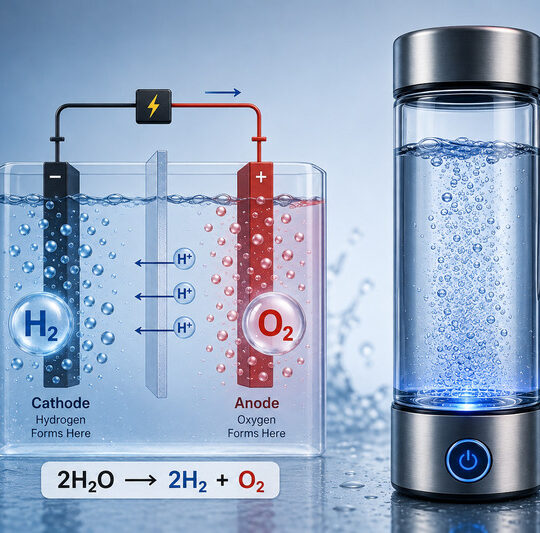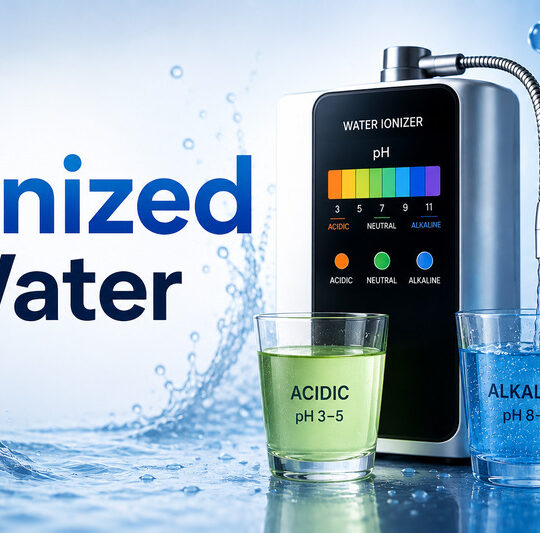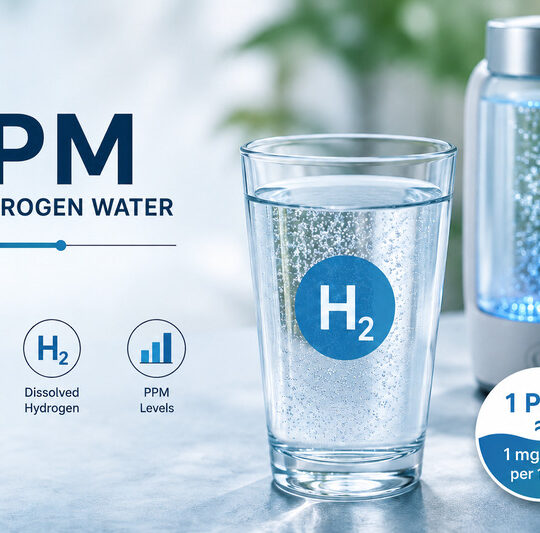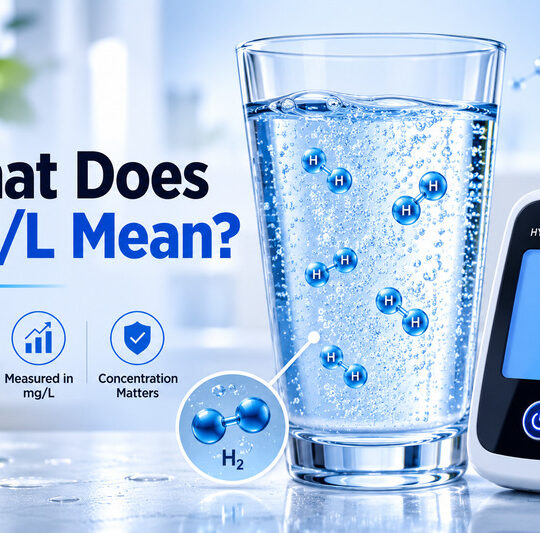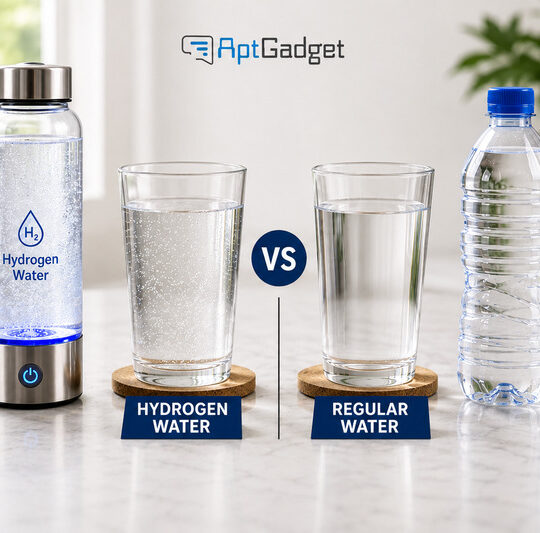
Hydrogen concentration is the amount of molecular hydrogen (H₂) dissolved in water. It tells you how much hydrogen is actually present in the water and is usually measured in ppm (parts per million), ppb (parts per billion), mg/L, or mmol/L.
En hydrogen water, concentration is one of the most important measurements because it represents the actual amount of hydrogen available for consumption. A product may be labelled as “hydrogen-rich water,” but the real value depends on how much dissolved hydrogen it contains.
Unlike ORP (oxidation-reduction potential), which measures the overall electrical properties of water, hydrogen concentration directly measures the amount of molecular hydrogen (H₂).
Key Takeaways
- Hydrogen concentration measures the actual amount of dissolved molecular hydrogen (H₂) in water.
- The most common measurement units are ppm, ppb, and mg/L.
- ORP readings do not directly show hydrogen concentration and can be affected by other factors such as pH and minerals.
- Accurate measurement requires specialized tools such as gas chromatography or calibrated hydrogen sensors.
Hydrogen Concentration Measurements
Hydrogen is a gas, and only a limited amount can dissolve into water. The concentration tells us how much of this dissolved hydrogen is present.
The most common measurement units are:
Parts Per Million (ppm)
PPM means “parts per million.”
In hydrogen water:
1 ppm ≈ 1 mg/L
This means one milligram of dissolved hydrogen exists in approximately one litre of water.
PPM is often used when discussing hydrogen concentration because it provides a simple way to compare different products and research studies.
Parts Per Billion (ppb)
Because dissolved hydrogen levels are usually small, manufacturers often report concentration in ppb.
Examples:
- 500 ppb = 0.5 ppm
- 1,000 ppb = 1 ppm
- 1,500 ppb = 1.5 ppm
A product advertising “1,000 ppb hydrogen water” is simply reporting that the water contains approximately 1 ppm of dissolved hydrogen.
What Are Normal Hydrogen Concentration Levels?
Hydrogen concentration varies depending on the tecnología used to create and store hydrogen water.
Typical ranges include:
| Hydrogen Level | Approximate Concentration |
|---|---|
| Low hydrogen water | Below 500 ppb |
| Common hydrogen water products | 500–1,500 ppb |
| Higher concentration systems | Above 1,500 ppb |
| Laboratory research solutions | Depends on the study design |
Many hydrogen water studies use carefully controlled concentrations because researchers need to know exactly how much hydrogen participants consume.
The concentration used in a study is important because a product containing a much lower hydrogen level may not deliver the same amount of hydrogen evaluated in that research.
Hydrogen Concentration vs ORP: Why They Are Different
One of the most common misunderstandings in hydrogen water is assuming that ORP represents hydrogen concentration.
It does not.
ORP stands for oxidation-reduction potential. It measures the tendency of water to gain or lose electrons, expressed in millivolts (mV).
While hydrogen can influence ORP, many other factors also affect the reading, including:
- pH level
- dissolved minerals
- temperature
- other compounds in the water
- electrode condition
Because of this, two water samples can have similar ORP values while containing very different amounts of dissolved hydrogen.
A low ORP reading may indicate reducing conditions, but it does not prove a specific hydrogen concentration.
For this reason, researchers do not use ORP alone to measure hydrogen content.
How Hydrogen Concentration Is Measured
The most accurate methods for measuring dissolved hydrogen include:
Gas Chromatography
Gas chromatography is a laboratory method used to measure the amount of hydrogen gas present in a sample with high accuracy.
It is commonly used in scientific research because it provides a direct measurement of hydrogen concentration.
Dissolved Hydrogen Sensors
Specialised hydrogen sensors can measure dissolved H₂ levels directly. These are often used for product testing and laboratory analysis.
Home Testing Methods
Some consumer testing kits can provide an estimate of hydrogen concentration. These methods can be useful for general comparison but are usually less precise than laboratory equipment.
Testing conditions also matter because hydrogen escapes from water quickly once exposed to air.
Why Hydrogen Concentration Matters
Hydrogen concentration matters because it connects hydrogen water products with scientific research.
Clinical studies do not simply test whether water contains hydrogen. They measure:
- how much hydrogen is consumed
- how often it is consumed
- how long the hydrogen remains available
The concentration determines the amount of molecular hydrogen delivered in each serving.
For example, if a study uses water containing a specific hydrogen concentration, a product with significantly lower levels may not provide the same hydrogen exposure.
This is why concentration is often more meaningful than general marketing terms such as:
- hydrogen activated water
- antioxidant water
- negative ORP water
- hydrogen technology
Related Terms
Sources and Further Reading
Juantorena, A., Santoyo, E., Lastres, O., Hernández, G., Bustos, A., Gamboa, S., & Sebastian, J. (2016). Gas chromatography as an analytical... Green and Sustainable Chemistry, 6(2), 78–87. https://doi.org/10.4236/gsc.2016.62007
Zhang, R., Ai, S., Long, M., Wan, L., Li, Y., Jia, D., Duan, H., & Chen, D. (2024). Quantitative study on hydrogen concentration... Metals, 14(7), 763. https://doi.org/10.3390/met14070763
Zito, P. F., Brunetti, A., & Barbieri, G. (2023). Hydrogen concentration... Renewable Energy, 218, 119243. https://doi.org/10.1016/j.renene.2023.119243