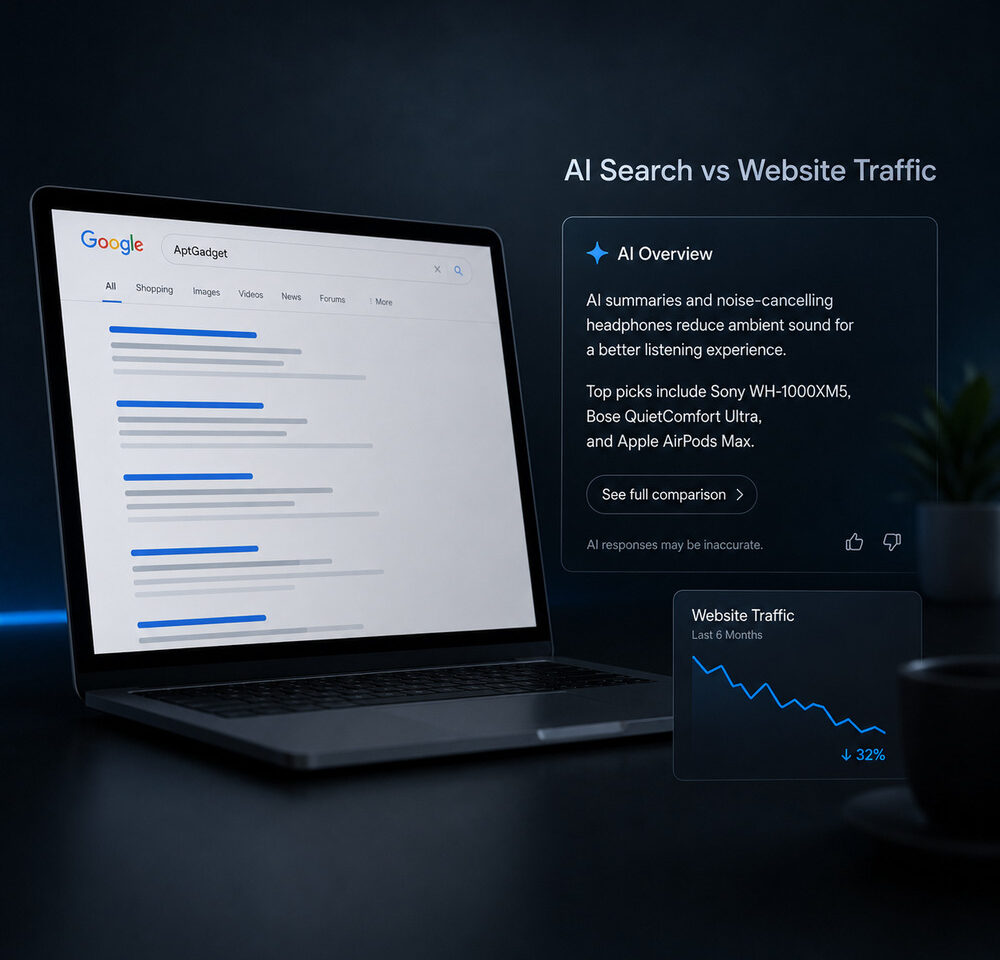

The way users discover websites is undergoing a structural shift as AI-powered search tools increasingly replace traditional “blue link” results with direct, synthesized answers. Platforms such as Google AI Overviews, ChatGPT, Microsoft Copilot, and Perplexity are now acting as intermediaries between users and the open web, reducing the need to click through multiple websites to find information.
Google’s AI Overviews, which generate summaries directly at the top of search results, are one of the most visible examples of this change. According to Google’s official documentation, the feature is designed to help users quickly understand complex topics while still providing links to supporting sources.
However, this convenience is beginning to reshape the economics of web traffic.
AI Overviews and the Decline of Traditional Clicks
Early research suggests that AI-generated summaries are already changing user behavior. A large-scale academic study found that exposure to Google AI Overviews reduced traffic to Wikipedia pages by around 15%, showing that users often consume information directly within the search interface instead of visiting source websites.
Another study analyzing over 55,393 trending queries found that AI Overviews frequently appear above organic results and often surface sources outside traditional ranking systems. Research published on arXiv also indicates that generative search experiences can reduce click-through rates by satisfying user intent directly on the results page.
Overall, the data points toward a growing trend: users are increasingly getting answers without clicking through to original websites.
Publishers and the Traffic Problem
For publishers, this shift represents a structural disruption. For more than two decades, Google search has served as a primary source of referral traffic for billions of websites. That model is now being redefined.
As AI systems summarize content directly on the results page, fewer users are visiting original sources. This is particularly significant for informational content, where answers can be easily extracted and condensed into short summaries.
In many cases, AI-generated responses are effectively replacing the need for a website visit entirely.
At the same time, some analysts argue that the traffic that does remain may be more valuable. Users who do click through often arrive with stronger intent and better context, which can improve engagement quality despite lower overall volume.
Google’s Response and Source Visibility
Google has started refining how AI-generated results display and attribute sources. Updates include clearer citation labels and improved visibility for original reporting within AI Overviews.
These changes highlight a key tension in modern search: balancing fast AI-generated answers with the need to support an open web ecosystem that still rewards content creators.
The challenge lies in maintaining both user convenience and publisher sustainability.
SEO Is Shifting Toward Authority, Not Just Rankings
As AI systems play a larger role in selecting information, SEO strategies are also evolving.
Instead of focusing only on keyword rankings, publishers are now prioritizing:
- topical authority
- original reporting
- structured and easy-to-extract content
- strong source credibility
AI search systems often prioritize content clarity and authority rather than traditional ranking positions. This means that being highly ranked on Google is no longer enough to guarantee visibility in AI-generated answers.
This shift is leading to a new approach known as answer engine optimization, where the goal is not just to rank, but to be cited as a trusted source.
The Future of Web Discovery
Traditional search engines are still dominant, but AI is quickly becoming an additional layer in how users access information. Instead of simply listing links, search systems are evolving into tools that interpret and summarize content directly.
In this emerging environment, websites may gradually shift from being final destinations to becoming data sources for AI systems.
Final Take
AI-powered search is not just changing how users find information; it is changing what visibility on the web actually means.
The internet is moving from a click-based discovery model to a citation-based intelligence model. Instead of competing for positions on a results page, websites are increasingly competing for inclusion inside AI-generated answers.
As this shift continues, success online will depend less on ranking in search engines and more on being trusted, referenced, and selected by AI systems.